We are happy to announce that the research cluster ‘Evidentiary Syntheses’ is nominated for the Ars Electronica Campus Award.
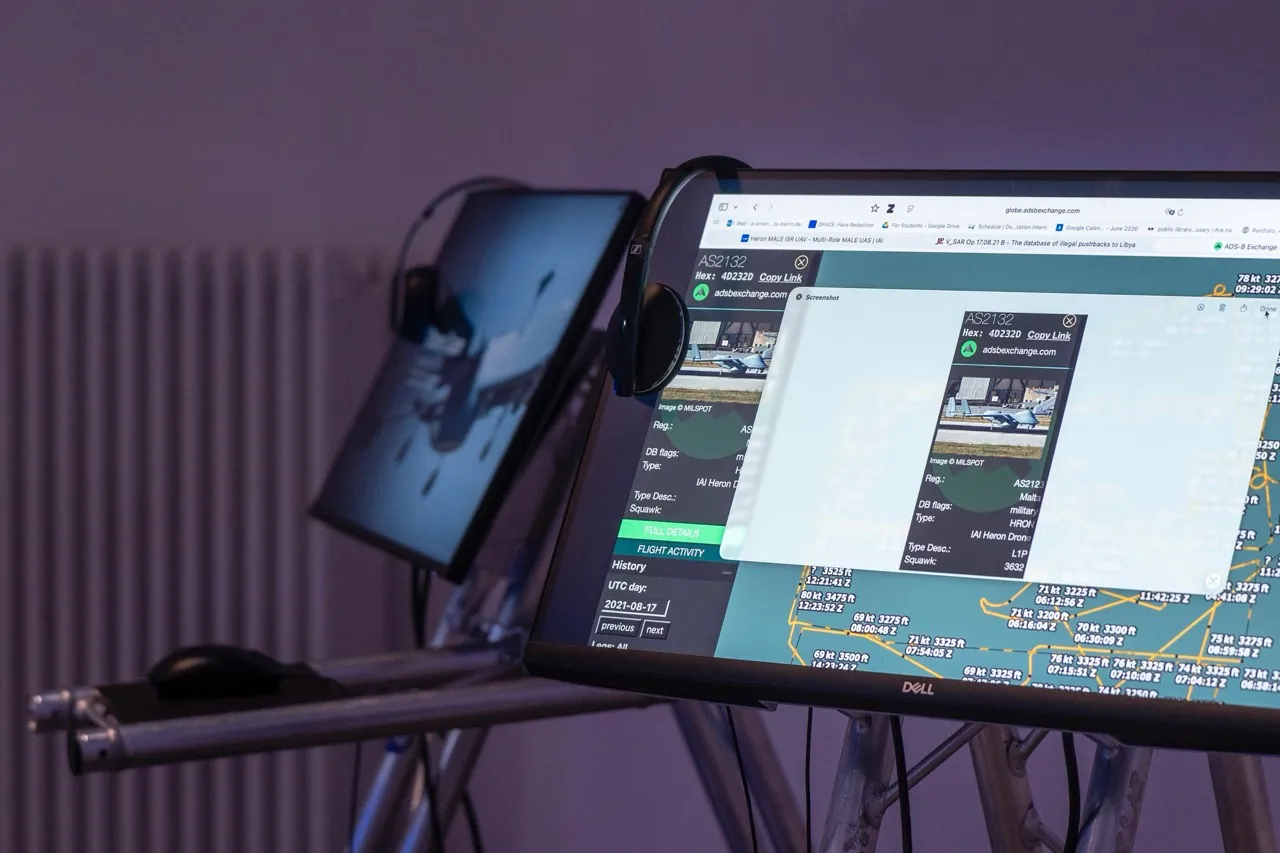
‘Evidentiary Syntheses’ is a dialogue of two approaches towards methods of reconstruction, making spatial configurations and events legible: ‘Situated Sound Composite: Drone Scape’ and ‘Cementing The Occupation: Pipelines of Bureautic Dispossession’.
The Ars Electronica Campus Award recognizes the most outstanding project presented within the Campus Exhibition and we’ll be crossing our fingers for them! The award ceremony will take place on Sep 12th, 17:30 – 19:00.
___
Situated Sound Composite: Drone Scape
by Ava Maria Simonds, Daniel Luca Donovan-Achi
Drone Scape investigates drone flights soundscapes over the Mediterranean in 2021 and their transformation of the horizontal landscape into a ‘space of death‘ (Sabeen Ahmed, 2018).We cross-reference open-source ADS-B exchange flight data of Frontex drones with reports from Borderforensics and Human Rights Watch. These reports contain testimonies from asylum seekers who were victims of push backs in the Mediterranean coordinated by Frontex drone surveillance over the Mediterranean and the Libyan Coast Guard.Often the only indication of these surveillance drones, and the subsequent inhumane and life-threatening „migration control“ processes, is the sound they produce. However, this sound is difficult to describe: it is not composed of distinct sounds, but rather a continuous hum. In the aforementioned testimony, it is simply described as ‚Wzz Wzz‘. In this case, the witness is an earwitness rather than an eyewitness.To understand „What does a pushback sound like?“, we reconstruct the flight path while calculating sound propagation through estimates of the propellers’ rotation and Doppler effects. We relate this to the calculated location of a vessel based on testimony, and the circular loitering motion of the drones. This simulates the unseen experience of the surveillance infrastructure in the Mediterranean route.